
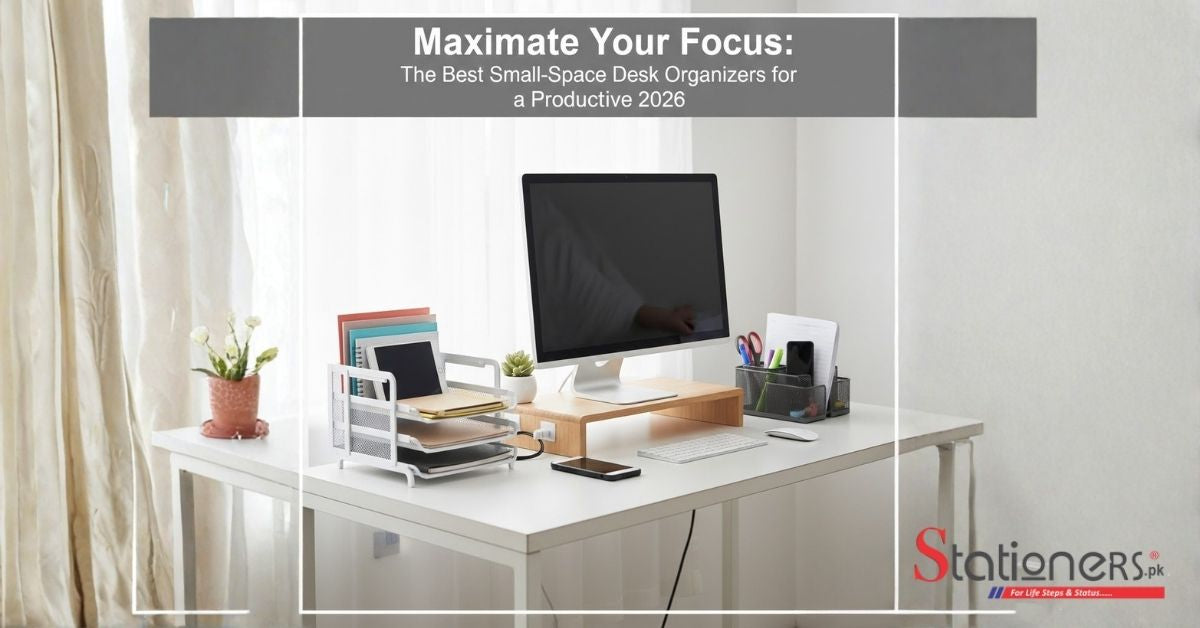
In the modern Pakistani professional landscape, the traditional sprawling office is quickly being replaced by compact home setups, co-working nooks, and study corners. Whether you are a student in a hostel room in Lahore or a remote developer in Karachi, the challenge remains the same: how do you fit a world of ideas onto a small desk? The answer lies in shifting your focus from "storage" to "systems."
A cluttered desk is more than just a mess; it is a cognitive tax that drains your ability to concentrate. When every square inch is occupied by stray pens and loose papers, your brain is forced to process unnecessary visual information. By selecting the right desk organizers, you aren't just tidying up you are reclaiming your mental bandwidth.
At stationers.pk, we understand that productivity is deeply personal. Creating a workspace that feels open, even when it is physically small, requires a strategic approach to the tools you use every day.
Maximizing Vertical Real Estate
When you run out of horizontal space, the most effective strategy is to build upward. Standard office setups often fail because they treat the desk as a flat plane. Vertical tiered trays and stackable bins allow you to categorize your essential documents and tools without expanding your footprint.
For instance, using a tiered file sorter for your active projects ensures that your "must-do" tasks are visible at eye level, while archival papers are kept tucked away. This verticality keeps the surface area directly in front of you the "focus zone" entirely clear for your laptop or notebook. By integrating these habits, you can see How Small Organization Habits Create Big Daily Improvements in your overall stress levels and output quality.
Consolidating Essential Office Supplies
The "death by a thousand cuts" for small desks is the accumulation of individual items. A stapler here, a tape dispenser there, and a cup for pens soon consume the entire table. The modern solution is consolidation. Multifunctional caddies that combine a pen holder, a small drawer for clips, and a phone stand into a single unit are game-changers for limited spaces.
Choosing professional-grade office supplies that serve dual purposes reduces the total number of objects on your desk. For example, a desk mat that doubles as a mousepad provides a defined boundary for your workspace, psychologically signaling to your brain that it is time to work, while also protecting your desk and reducing clutter from secondary pads.
The Psychology of the "Clear Zone"
Productivity experts often talk about the importance of a "clean sweep" at the end of each day. In a small space, this is only possible if every item has a dedicated home. If your organizers are too bulky, you will likely leave things out on the desk rather than struggling to put them away.
Compact, modular organizers allow you to customize your setup based on your dominant hand and your specific workflow. If you are left-handed, your most-used tools should be on the left; if you primarily work digitally, your stationery should be tucked into a monitor riser or a side drawer. This eliminates the "friction" of tidying up. When the act of organizing becomes effortless, you are much more likely to maintain a clear zone, which is the foundation of deep work.
Choosing Materials for Durability and Aesthetics
In Pakistan’s climate, the durability of your organization tools matters. Metal mesh organizers are a favorite because they are lightweight, allow for airflow reducing dust accumulation and are virtually indestructible. However, for those looking to create a more "aesthetic" or Pinterest-inspired workspace, acrylic or wooden organizers can add warmth and a premium feel.
The visual weight of your organizers also plays a role in how "tight" the room feels. Clear acrylic organizers, for example, "disappear" into the desk, making the space feel larger than it actually is. On the other hand, solid black or dark wood organizers provide a grounded, executive feel. Matching your organizers to your desk color can create a seamless, monochromatic look that minimizes visual distractions.
|
Organizer Type |
Best For |
Space-Saving Benefit |
|
Tiered Mesh Tray |
Documents & Folders |
Uses vertical height instead of width |
|
Monitor Riser |
Screens & Laptops |
Creates a "garage" for the keyboard |
|
Cable Clips |
Tech & Charging |
Prevents wire "spaghetti" on the surface |
|
Modular Caddy |
Pens & Small Tech |
Combines multiple tools into one footprint |
Implementing a "One-In, One-Out" Rule
Even with the best organizers, a small desk can eventually become overwhelmed. To maintain high productivity, adopt a minimalist mindset regarding your supplies. High-quality stationery should be a joy to use, not a burden to store.
Instead of keeping ten different black pens in a cup, keep your two favorites and store the refills in a drawer. This "one-in, one-out" rule ensures that your organizers never become overcrowded. A well-organized desk should feel like it has "room to breathe," giving you the mental space to tackle complex problems without feeling boxed in by your environment.
Frequently Asked Questions
How do I choose the right size of organizer for my desk?
Measure your "focus zone" first the area where you type or write. Any organizer you buy should fit comfortably outside this zone. If it forces you to move your keyboard to the side, it is too large for your space.
What is the best way to manage cables on a small desk?
Use adhesive cable clips on the back or side edge of your desk. This keeps your charging cables accessible but prevents them from cluttering the surface when not in use.
Are wooden organizers better than plastic ones?
It depends on your environment. Wood offers a classic, sturdy feel but can be sensitive to humidity. Plastic or acrylic is more affordable and easier to clean, making it great for high-use student desks.
How often should I reorganize my desk?
A daily "reset" of 2 minutes at the end of your workday is best. A deeper reorganization should only be necessary every few months as your projects or tools change.
Can I use kitchen organizers for my desk?
Yes, cutlery trays are actually excellent for desk drawers to keep pens, rulers, and scissors separated and easy to find.
Does a clean desk really improve grades or work performance?
While everyone’s working style is different, most people find that reducing visual clutter lowers cortisol (stress) levels and makes it easier to enter a "flow state" for complex tasks.